- Details
- Hits: 1292
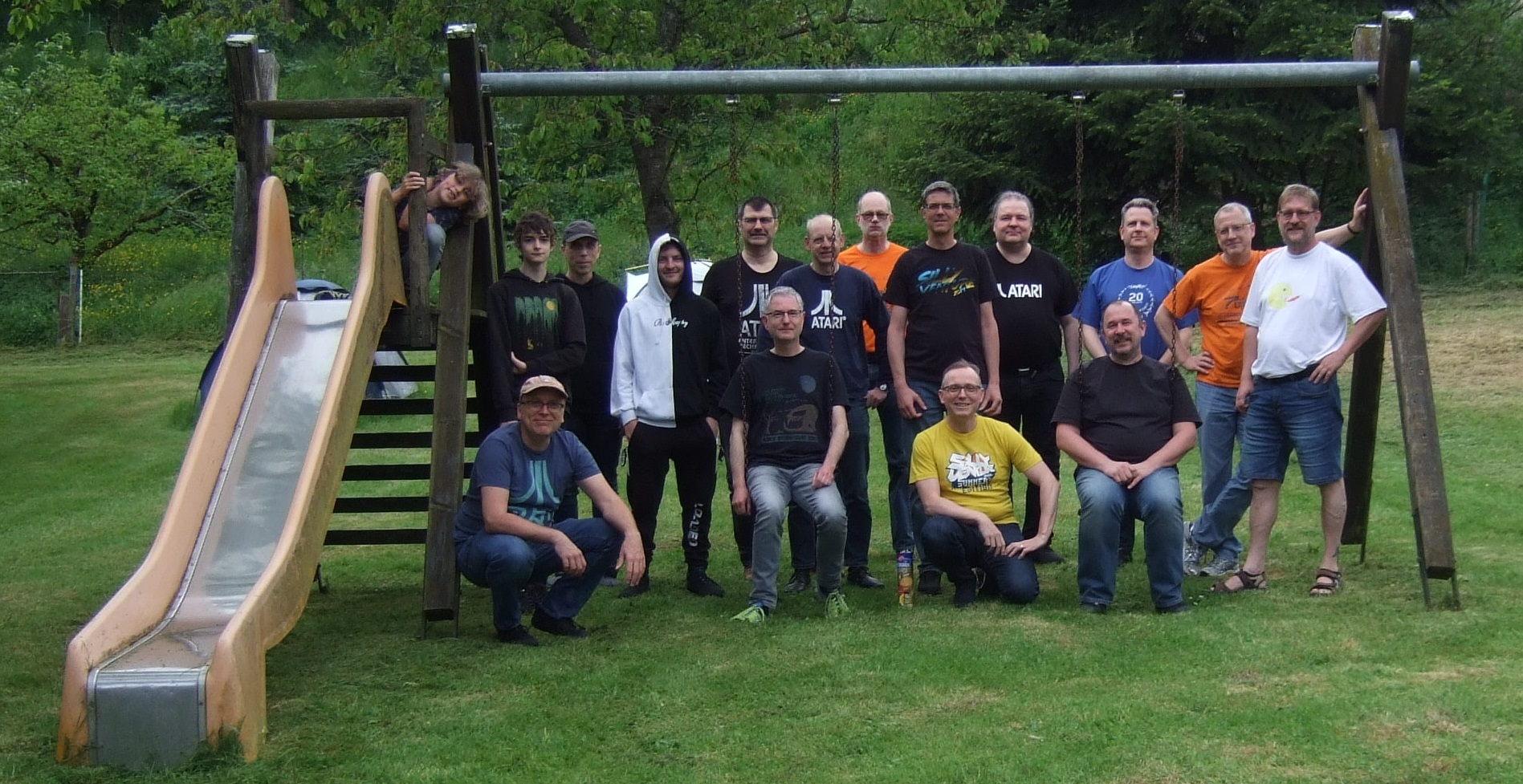
R.I.K. organized another edition of H.A.T.Z., and I had the luck of being there for full three days. On day one, I checked all the Atari computers I had brought. Then Roland Wassenberg and I reconstructed the type-in assembly game "Gunfight". Lots of fun with the assembly source not matching, and the assembly listing is even different from the printed memory dump. I think the author didn't use the assembler described in the book. On day two, I created a new version of "The!Cart Studio" with several fixes since the last stable release in 2020. I also managed to add support for the latest Boot Manager version from 2022, which has been used by all Homesoft disk compilations recently. The rest of the day, I coded in Mad Pascal and Mad Assembler to get the graphics and colors rights in a "soon" to-be-released game by R.A.F. On day three, I made "The!Cart Studio" work again with Java 8 so existing users can use it without problems. Thanks to Tron04 for the quick feedback and testing. Then I created a small tool in HTML and Javascript to convert texts for Mad Assembler. With this, I'll be able to improve the built-in help texts of MADS. Ultimately I spent the rest of the day enjoying the never-ending thrill of using tape drives. It is unbelievable what can go wrong - EVERYTHING!
Nevertheless, it was a great time with lots of fun. On day four, Tigerduck and I played a few rounds of Robix (by Raster) and Scorch (by Pirx and the team). And ultimately, with the support from the guys from Pigwa, my video tutorials are now all also available there for download - just in case youtube goes down one day :-)
Thanks to everybody who participated; this was a lot of fun. See you at Fujiama!
- Details
- Hits: 1300
With almost 40 years of experience in computers and writing software, I believe architecture should follow common sense and reality. This is frequently contrasted by "this is the one-serves-all solution" hypes and buzzwords created by youngsters or marketing people. I recommend reading the following two articles to both groups of people.
- Amazon: Scaling up the Prime Video audio/video monitoring service and reducing costs by 90% (PDF) online.
- David Heinemeier Hansso: Even Amazon can't make sense of serverless or microservices (PDF) online.
- Details
- Hits: 1867
On March 11, 2023, Andreas Gustafsson, aka. Shadow (Sdw) died unexpectedly in an accident.
I was returning from Midwinter Meeting when the news reached me. Two weeks before, I had sent him my appreciation for the beautiful latest Atari VCS release he had created with Mermaid. Andreas was an outstanding demoscener in many regards. Not only he made over 130 demos - each of them was a gem and some even milestones. He had the unique passion and ability to create demos on everything that consumed electricity and that could be programmed. His skills were not only in the area of coding but also in the area of design. He always impressed me with the color schemes he used and with the brilliant ideas to overcome the limitations of every piece of hardware. His work was a source of inspiration for many of us and me personally. Some of my best demos were humble attempts to adapt his ideas.
He was always kind and helpful to many of us, and I am happy that I could help him a few times when the chips in the Atari didn't want to obey his commands. I owe him many cheerful moments in my life. We've lost one of the best, and I am deeply saddened that I have to write these lines. If you want to express something, you can write in his obituary.
You can find the list of his releases on these websites, and I'm pretty sure none of them covers all of what he did. The screenshot below needs no further explanation.

- Details
- Hits: 1309
Finally, I've filled the pages for the "Atari Action!" system and the "Atari Action! Editor" with content.
The "Atari Action!" manuals in English and German are now also included in the Sourceforge repository.
The "Atari Action! Editor" manuals in English and German are now available as separate downloads.
The previous download of the temporary versions from wudsn.com has been removed. The official builds are now always at Sourceforge.
- Binaries: https://sourceforge.net/projects/atari-action/files
- Source Code https://sourceforge.net/projects/atari-action
- Details
- Hits: 1962
This release lays a new foundation for WUDSN IDE in many respects. The inner structure of the IDE has been reworked so that it can be extended to other languages beyond 6502 assembly languages. The main reason is that I want to make it the primary development environment for Mad Pascal. I consider Mad Pascal the most crucial step forward in development for my beloved Atari 8-bit platform. Its perfect integration with Mad Assembler allows one to use the best high-level and low-level languages in one project. The level of reuse possible via Mad Pascal Units is unmatched in the 8-bit world.
Java and Eclipse
- The minimum requirements are the same as for WUDSN 1.7.2, i.e., Java 11 and Eclipse 4.19 or newer.
Installation
- Perform a new fresh installation using the new WUDSN IDE installer scripts.
They are available for 64-bit Windows, 64-bit macOS, and 64-bit Linux. The installer will automatically download and install all required components like Java, Eclipse, compilers, tools, and example projects. All information is available on the updated Installation page. The installer replaces the previous Windows-specific "zero-installation" downloads. Unlike the "zero-installation" downloads, the new installer scripts allow installing WUDSN IDE into freely chosen folders on your hard drive. This way, you can also have multiple installations in parallel. - This a major version change, so a new empty workspace folder for the new version.
The installer creates such a folder for you. If you update or install manually, use a new empty workspace folder or delete the ".metadata" folder in the existing workspace folder. Otherwise, you will see errors caused by incompatible settings and entries from the "WUDSN IDE 1.x.x" versions.
Releases
- Stable and daily versions are now available via separate update site URLs.
The recommended version to use is the stable version. The daily version is available so reporters can test bug fixes and new features before pushing them to the public. - The new default updates site URL is https://www.wudsn.com/update/stable
The old https://www.wudsn.com/update update site is no longer available.
If you need to install old plugin versions, use the version-specific update site on the Releases page.
Source Code
- All WUDSN IDE-related source codes are now available on GitHub
- https://github.com/peterdell/wudsn-ide-install - WUDSN IDE Installer
- https://github.com/peterdell/wudsn-ide - WUDSN IDE
- https://github.com/peterdell/wudsn-ide-tools - WUDSN IDE Tools (assemblers, compilers, ...)
- https://github.com/peterdell/wudsn-ide-projects - WUDSN IDE Example Projects (for every target platform)
- This way, you can more easily download individual files and follow the progress of the projects.
Bug Reports and Feature Requests
- You can now report bugs and file feature requests directly via GitHub.
Just click on the Issues section of the respective project. This lets you vote for fixes and features, comment on them, and receive notifications when something is created. Feature Requests should be tagged as "enhancement".
Source Compatibility
- All source code from previous versions of WUDSN IDE will continue to work in the new version.
- Use the new annotation prefix "@com.wudsn.ide.lng" instead of "@com.wudsn.ide.asm".
The old prefix is deprecated because the IDE now supports multiple languages. If you used the old prefix, it results in warnings during compiling for now.
Behind the Scenes
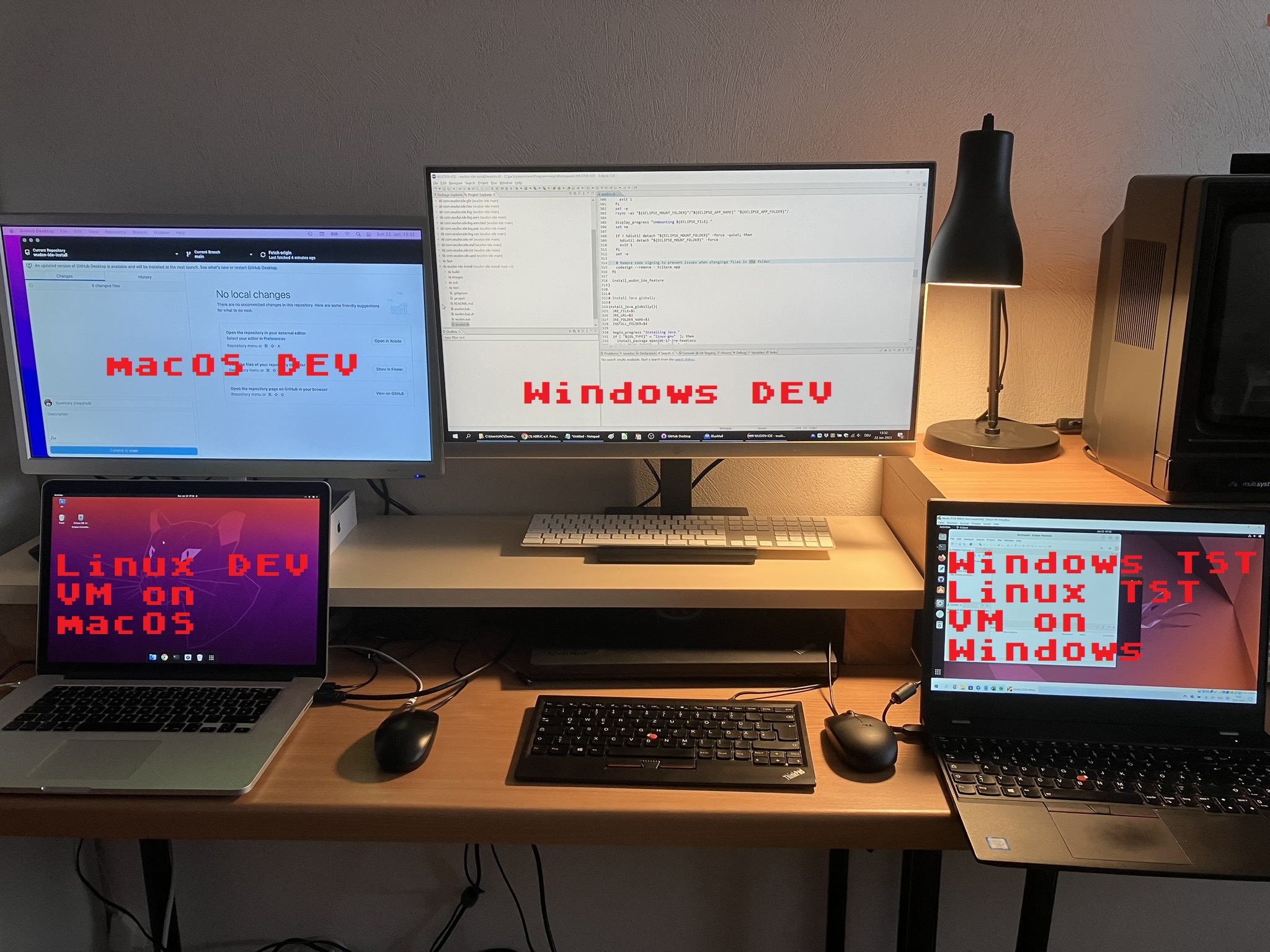
In the past 14 years, WUDSN IDE has grown immensely, and creating a new WUDSN IDE release became increasingly complex: more assemblers, more support target platforms, and more requests for operating systems like macOS or Linux. Because building a release consisted primarily of manual steps, and testing was tedious to impossible (for example, I didn't own a macOS machine). So something like a preview for testing was unthinkable without investing a whole day of work. Ultimately, I didn't want to code something in the IDE anymore because 5 minutes of coding resulted in hours of painful post-processing.
But since I want the IDE to continue and evolve, I've invested several months to break the vicious circle and prepare my development cycle for prime time. This included:
- Splitting up the sources
- Getting familiar with git, after all
- Moving all sources to GitHub
- Establishing issue management Github
- Buying an Intel-based MacBook Pro
- Buying an M1-based Mac Mini
- Setting up Linux VMs for development on macOS
- Setting up Linux VMs for testing on Windows
- Creating and testing installation scripts for Windows
- Transcribing the installation scripts to Unix shell scripts
- Testing the installation scripts on macOS
- Generalizing the installation scripts for Linux
- Creating test scripts for automated tests on the development machines (aka. "Does it work here?")
- Creating test scripts for automated clean-installation tests on the test machines (aka "Will it work there?")
- Reworking all source code to use the language as an additional dimension
The process took several months, and it finally pays off. I guess that's where all progress comes from: Underestimating the actual time and effort something will take :-). This is what my new workplace looks like, and below that picture, you can find a short video (German language) where I demonstrate the new workflow when using GitHub.